
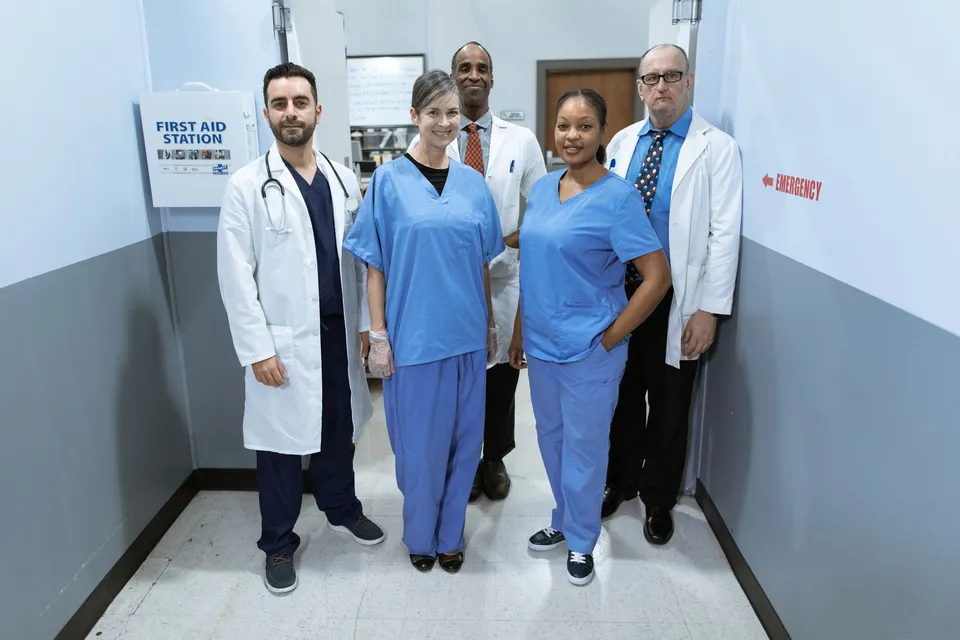
Minneapolis has a care economy that is bigger than the badge on the front door. A job seeker can start at a downtown trauma center, move through a neighborhood clinic, and end up in a classroom or support office without ever leaving the same local network. Hennepin Healthcare says its main campus is in downtown Minneapolis and notes primary care service in Southeast Minneapolis at East Lake, which is a good reminder that local health work is spread across corridors and neighborhoods, not just concentrated in one hospital tower .
That matters because the city’s major employers show how many different kinds of work sit inside the same sector. Minneapolis’ principal-employer list includes Hennepin Healthcare, Allina Health, the University of Minnesota, Wells Fargo, Target, Hennepin County, and U.S. Bancorp, while the broader metro headquarters list includes health, food, logistics, finance, and industrial firms. In practice, Minneapolis health care is not only physicians, nurses, and therapists. It also depends on registration, scheduling, patient transport, food service, environmental services, records, billing, pharmacy support, and facilities work .
For applicants, that mix is encouraging but not automatic. DEED’s metro vacancy data show 66,411 vacancies in the seven-county Twin Cities area in 2024, with a 3.8% vacancy rate and 0.7 unemployed persons for every vacancy. The 2023 metro report also found that 27% of vacancies were part-time, 5% were temporary or seasonal, 50% required one or more years of experience, and 39% required some postsecondary education. That combination suggests a labor market that is active but selective: many employers are still recruiting, yet candidates need a realistic match between schedule, credentials, and the exact worksite they are applying to .
The best local care pathways reflect that reality. Minneapolis College’s Nursing Assistant program is a useful example because it is tied directly to work, not just classroom theory. The college says the program prepares students for long-term care, acute care, and home care under a nurse’s supervision, and that completion makes students eligible for the Minnesota Department of Health exam for placement on the Nursing Assistant Registry. Its continuing-education version is hybrid, runs on Fridays and Saturdays, and combines online and in-person coursework. For people who are already working, that schedule detail matters as much as the program name because it shows how a credential can fit around an existing paycheck .
That same “fit the schedule to the life” idea shows up elsewhere in the city’s training ecosystem. Minneapolis College says its broader career-start options include short-term programs that can be completed in as few as 5 weeks or 5 months, while the University of Minnesota’s Twin Cities campus offers nondegree registration and continuing education with online and evening options. Even when someone is not aiming for a clinical role, the city’s educational network gives local workers a way to build toward office, coordination, or technical positions without starting over from scratch .
Pay rules are another detail that changes how Minneapolis work should be read. The city says its 2026 minimum wage is $16.37 for all employers, above Minnesota’s 2026 state minimum wage of $11.41, and that the city standard applies to work performed in Minneapolis even when the employer is based elsewhere. The city also says workers performing at least two hours of work in a calendar week within Minneapolis are covered. For applicants, that means the worksite is not a small detail. For employers, it means a clinic, office, or service shift inside the city can carry a different wage floor than the same employer’s suburban location .
Minneapolis is also a city where the human side of care work shows up in the geography. The city’s neighborhood materials show a dense network of neighborhoods, corridors, and civic organizations, and the neighborhood-organization page lets residents look up contacts, board meetings, plans, bylaws, and financial information by address. That may sound unrelated to health care, but it is useful for workers who are new to the city. A person taking an early shift at a hospital or clinic often needs to understand not just the job site, but the household routines, transit links, and neighborhood supports around it .
For employers, the takeaway is simple: Minneapolis care hiring works best when role design is honest about the real entry point. If the job is patient-facing and schedule-heavy, say so. If it is a support role that can be learned through a short training path, make that clear. If the shift depends on a city worksite and a city wage floor, build that into the offer. The local labor market is wide enough to support all three approaches, but only if the posting reflects the actual work rather than a generic title.
For applicants, the best question is not just “Is there a health-care job?” It is “Which part of the care system fits my schedule, my transportation, and my next credential?” In Minneapolis, that answer might be a downtown hospital department, a Southeast clinic, a weekend training program, or a support role that opens the door to the next step.
If you want to compare direct-hire options or talk through where your background fits, start with apply or employers.